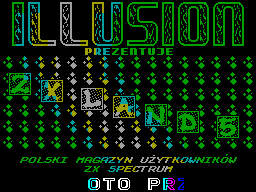
Demoscene: What Is It and What Is It For?
I'll start by saying that this article will be practically useless to people who already know the scene. It probably won't be much use to those who know nothing about it either, but perhaps it will help them understand some of the terms and draw them into the world of demos.
But let's start at the beginning.
What is a demo? The word comes from “demonstration”—a presentation of capabilities. In our case, it means the capabilities of the hardware or, as some people claim, the talent of the authors. Personally, I agree with the latter opinion.
The first demos on the SPECCY were programs containing music extracted from games and played through the beeper (the built-in speaker). Many games had wonderful music. People who “cracked” games—the so-called HACKERs—started “ripping” that music and putting a dozen or so tracks together in one program. From then on, you only had to load a demo to listen to music, rather than loading the whole game. Before long, simply pressing keys to listen to a track was no longer enough. People began adding pictures and printing various messages in which they sent greetings to their friends, as well as impressive scrolling text (scrolls).
When the AY add-on appeared, a great many demos were made as well. This add-on had enormous capabilities.
But that soon became boring too, so authors started adding ever more imaginative effects: VOLUMETERs, animations, wonderful graphics, logos, and so on (see the glossary).
One author after another tried to outdo the rest with new ideas and be THE BEST. In this way, competition developed among demo makers. It certainly wasn't about hating the competition because someone else could do more (although that happened too!). On the contrary: they shared their experience, told each other what could be done and how, improved their productions, sent greetings to friends in them, and encouraged one another to make more programs.
Not everyone could do everything on their own. Their demos might therefore contain lots of good graphics but poor code and average music taken from a game—or fairly good code, but low-quality graphics and music, and so on. To make their productions more and more interesting, some people decided to join forces: musician + graphic artist + coder. Such a team is called a group.
The phenomenon that brings together all the groups, as well as individual authors, is called the DEMOSCENE.
All right, now we know what a demo and the scene are, but... what the hell are they for? If that's how you see it, I can say that you don't use your wonderful computer for anything besides games. You could stop reading here. Still, allow me to philosophize a little.
First of all, you have to realize that making demos is completely altruistic fun. There's no money in it, nor anything useful. They exist only for the viewer, and often make their eyes and ears pop and their jaws drop.
But how does someone go about making a demo?
A common reason is simply getting bored with games. There comes a time when you want to make something, to use the computer for more ambitious purposes.
Those with artistic inclinations reach for graphics programs; those with an ear for music want to use their advantage and compose music (often developing their talent in the process); still others, wanting to do something useful, write their first programs. In time, they want to solve increasingly difficult problems.
Then comes the moment when they decide they should show their work to someone—and that's exactly what demos are for.
If someone is good at what they do and astonishes some old sceners with their program, they get greetings in other demos, letters of congratulations, and so on. The scene starts taking an interest in them. It encourages them to create more productions. Sometimes they also get an invitation to join a group—and that's something!
Demos usually spread very quickly, and the viewer grabs their head and mutters, “What else are they going to squeeze out of this Speccy?!?”
While reading this article, you probably came across some unfamiliar terms. So here's a
Computer Glossary
DEMO — a program showing the capabilities of the hardware and the creative talent of its authors.
GRAPHIC ARTIST — someone who draws pictures, logos, and fonts.
FONTS — a graphic set of characters, usually large letters with interesting shapes.
LOGO — a kind of calling card: a graphic containing the name of a group, a product, and so on. Usually it consists of distinctive lettering with a background behind it.
MUSICIAN — a person who creates the soundtrack.
CODER — the most important member of a group. They put the graphics and music together, add visual effects, and assemble the demo as a whole.
SCROLL — smoothly scrolling text, usually used to convey information. Often used, in an expanded form, as the main effect in a demo.
ANIMATION — drawings shown frame by frame, creating the effect of a short film.
VOLUMETER — a volume meter: a graphic representation of music that changes according to the sound level.
PYZA
Share your thoughts about the article