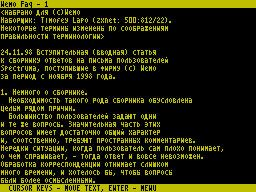
18.11.98
Bakulev Alexey, Izhevsk
Please send me the latest issue of the ZX FORMAT magazine and your new price lists. Can I buy an HDD IDE controller from you without the Is-Dos OS? I already have it.
Could you tell me how to modify your controller so it can handle a hard drive larger than 80 MB? For example, I’ve accumulated 150–200 MB of software.
Do you have an email address or even a separate website? Mail takes up a lot of time.
By the way, how far along is “Transformer”? Please tell me how many clock cycles the Z180 takes for these instructions:
LD (NN),hl; pop hl; push hl; ldi; ldir(I want to estimate what kind of screen the Z180 can handle.)
P.S. By the way, I visited the Zilog site and saw another processor family there—Z380.
-
Any purchases, including ZX-F, are strictly prepaid. The rule is ironclad: money in the morning, chairs in the evening. We don’t do cash on delivery.
-
The HDD controller is not sold without the Is-Dos OS. We have certain obligations to IskraSoft. Its cost is included in the hardware, no exceptions. You say you already have Is-Dos. What year is it from? The system changes—that is, it gets revised, improved, optimized, and so on.
<TL’s note: What matters isn’t so much the system itself as the set of drivers for the IDE controller.>
Not just annually, but quarterly. So Is-Dos98 is not quite the same as Is-Dos97, and is even less like Is-Dos96. Serious costs have gone into this product, and they have to be recouped (see, for example, ZXF#8).
In any case, the controller also comes with a hard drive—it’s recommended that you buy the complete set.
-
No modifications to the controller are required. The mere fact that this idea occurred to you shows that you need to reread point 2 of this letter. The ability to connect a drive larger than 80 MB is achieved through software, not hardware.
Now, about that 80 MB figure: that’s the size of the continuous operating space controlled and managed by the OS. But a single drive can have as many such spaces as you like. By comparison, in Smuce this size is… 640 KB, regardless of the physical size of the drive (if you can even speak of operating space in Smuc’e).
-
Mail takes up a lot of your time, and a website would take up even more of mine. I have access points on the networks, but I use them only for business, not for chatter. Of course, I could “drink up all the filth of the Ganges,” and nothing would happen to me. The problem is, it would take more than one lifetime.
<TL’s note: The last two sentences are an absolute gem, worthy of being embossed in gold. Note that this is written in complete seriousness :) >
Here’s an example:
A query about an RS-232 interface appears on the network. A well-meaning correspondent starts explaining how the VV51 chip works in software. As they say, one is “talking about Thomas” and the other “about Jeremiah.” But they had a substantial conversation all the same, since neither of them had the faintest idea what an interface was. The person who made the query thought to call me. I had to spend about two hours of working time explaining what an interface is, and another half-hour explaining exactly how the RS-232 interface differs from all the others. I did this as, so to speak, an experiment. Imagine how much time that would have taken through a terminal instead of in a direct conversation. I think my hands might have fallen off…
These are the general problems with networks—noise. They have no mechanisms for “raising” information; it’s more a matter of “enriching the raw material” than filtering it. When the volume of information being “dumped” onto the network depends...
depending on how persistent a particular user is and how quickly they type on the keyboard, there is no place for a professional there. In business, it is simpler to use the telephone.
- This is a common misconception about the “Transformer.”
First, it is not a project, but a conceptual development. Those are different things. A conceptual development may never become a project. Second, it is not the most realistic, but the least unrealistic. Note that those are different things too. This is not a specific object (say, a hardware design), but rather a direction for development—the most natural and justified one, in my view. The article was about which way we need to move, not about having it done in a year (two, three...). After all, it said “let’s dream,” “this is impossible for now,” and so on. It is an article about what is possible and necessary in the Spectrum from a hardware standpoint, nothing more. It is a statement of intent. Technically, it could be done tomorrow—there are no technical problems—but what would be the point?
At present, even the little that has been done in hardware is practically unsupported. I’m talking about solutions that have already “settled down” and are essentially standard: the DMMC turbo mode, the bus, the multicolor capabilities of the KAY—not all kinds of opportunistic architectural frills.
Very few new computers are being bought; the old ones are gathering dust. There’s no less stupidity around—in other words, people still think every problem can be solved in hardware. The common view is that the Spectrum lacks technical specifications. I see it differently: the Spectrum lacks consumer content and real demand for the capabilities it already has. In this situation, doing something completely new makes no sense. In its current form, the Spectrum is ideally suited to the range of tasks it is used for.
Whether the “Transformer” project is implemented depends first and foremost on the users, not on me: on the state of their wallets; on whether they are willing to buy new, modern equipment instead of taking apart old hardware in the kitchen; on getting an OS into widespread use (Is-Dos is necessary, because these standard resources cannot be controlled without a standard OS, just as they cannot be used effectively); on scrupulous and literal observance of copyright; and on the level of development of the Spectrum infrastructure. That’s what costs money, not the hardware and circuit diagrams.
Just as every nation deserves its ruler, every nation deserves its computer. It’s pointless to try to grow mold without dampness. And, above all, we need a new range of tasks for which the Transformer’s capabilities would be in demand.
Users, however, are very conservative in this respect. It takes years to break down stereotypes about the Spectrum, never mind the time needed to create new ones.
- For the number of clock cycles, see “User manual” (price list). The Z180 will drive the same screen as the Spectrum. The Spectrum screen is its foundation. This computer is ideal as a TV-based computer. It is still alive precisely because of that.
Don’t imitate Nikulin in “Samogonshchiki” and pull out the bottom pot—everything will come crashing down. The Amiga is declining in Russia partly because Commodore abandoned TV resolution. They made it bigger, but it turned out worse. Lusers squeal with delight at the sight of an Amiga, but the platform doesn’t function; there’s no structure. It proved unviable. In other words, an architecture like the Amiga’s does not lead to the creation of a platform (at least in Russia). The PC also is not
18.11.98 — Alexey Bakulev, Izhevsk
Fragment 3/3.
...as a criterion. The technical specifications of PCs are a pretext for stimulating and encouraging sales. People are taught to pronounce clever words without putting any meaning into them, and technical progress and technical specifications are declared to be absolute values, including consumer values. In reality, though, these are imaginary consumer values. They cannot be put to use or made marketable. The PC owes its widespread adoption above all to vast amounts of money (the Year 2000 problem alone will cost Russia half a billion), corruption, and a massive brainwashing campaign (the standard “under-the-table” payment to an official for buying a batch of PCs is about 5%, although, to be fair, there are also some genuinely committed idiots).
As for IBM’s organization of mass mind control (around 300,000 people on the corporation’s payroll), it has to be admitted that they do it very professionally. If you suddenly want something, it doesn’t necessarily mean that you came up with the idea yourself—maybe somebody really wanted you to want it. The PC is simply foisted on people, and aggressively, too.
Returning to the Spectrum, I’d like to say that it’s very important to know what can be changed and what can’t. When something is manufactured, money is committed years in advance, and how effectively it is used depends on real things, not on chimeras in users’ heads.
P.S. By the way, you forgot to include an envelope and/or stamps for a reply. Completely broke? Someone will have to pay for you, after all. Money doesn’t grow on trees. Think about it; it’s directly relevant to the subject of the letter.
I’m also interested in:
- Are “Korvet” cases still being made in Izhevsk?
- If not, are there any left in stock?
- What does a case cost, and would the factory consider bartering for finished “Spectrum” computers?
- Are ONC-114 connectors (7 pins) still being made—DIN sockets for mounting on a circuit board, plastic, mass-market?
Full designation: ONC-114-7/16-RP23
With your permission, the letter will be published on the SPbZXNET network, so to speak, to raise the general level of “chatter.” By the way, someone else will do the typing. It’s too much trouble for me.
Share your thoughts about the article