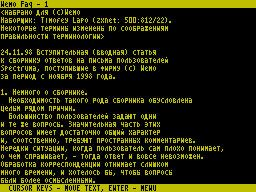
Prepared for (c)Nemo
Typesetter: Timofey Lapo (zxnet: 500:812/22).
Some terms have been changed to ensure terminological accuracy.
24 November 1998 — Introductory article to the collection of answers to letters from Spectrum users received by (c)Nemo since November 1998
1. About the collection
The need for this kind of collection stems from a number of reasons.
Most users ask the same questions. A substantial number of these questions are fairly general in nature and therefore require lengthy comments. It is not uncommon for a user to have a poor understanding of what they are asking; in that case, an answer is altogether impossible.
Processing correspondence takes too much time, and we would like the questions to be more considered.
After looking through the contents of the shell, many questions will probably answer themselves. This tool is more effective than replying to an individual user, and much more responsive than Spectrum media. Magazines call for more academic and fundamental texts; moreover, they are published infrequently. Spectrum networks are fragmented and do not form a single information space. In addition, a collection of this kind could presumably also serve an advertising purpose.
2. How to use it
Technically, the collection is a poor, heavily crippled version—or, more accurately, a set of IS-DOS system utilities.
TL’s note: On zx-net, it is distributed as a text file.
So please do not confuse the commercial IS-DOS product with this cut-down version. This technical solution is the most practical, though not impressive; as a tool, it is best suited to the purposes described in section 1.
2.1 Lexicographic search (pattern search)
If you are looking for information related to a particular topic, choose the most appropriate keyword (a proper name). For example: Z180, Z80, IS-DOS, and so on. You will get an information “slice” of the collection on the subject that interests you.
2.2 Printing
If necessary, you can use the standard IS-DOS procedure.
2.3 Finding the latest information
All letters have two dates: the date they were received and the date they were sent.
Enter a date query to get a “slice” by time.
2.4 Searching by location or person
If you want to find a letter from a specific person, enter their name and city. In the same way, you can find the answers to your own letter in the collection.
2.5 Format used for letters in the collection
The date the letter was received / the date of the reply, the correspondent’s name and city; then the text of the letter, followed by the reply from (c)Nemo.
3. Terms for distributing the collection and publishing letters
3.1
The collection is distributed as freeware, that is, freely. The first version of the shell is sent free of charge when a new user’s first letter arrives. For a repeat request from the same address, payment is required: as of 24 November 1998, this amounts to 8 × 1.8 = 15 rubles. Distribution of the shell on Spectruma networks or FIDO is permitted. Distribution on the Internet is prohibited.
3.2 Restrictions on publication
In addition to the generally accepted and commonly known restrictions (those observed on the networks), there are some others: political, immoral, or blatantly fraudulent subject matter. Such letters are not published.
Correspondence of a personal nature is also not published, or is published with omissions. Correspondence with companies working jointly with Nemo under the “Technology Export” program is not published. Letters are not published if the correspondent has explicitly stated—in the form of a declaration—that they prohibit publication. If a letter contains no indication as to whether it may be published, it is published in accordance with section 2.5 of this text.
Letters that are terse and banal in content, such as “Price list,” are not published. A correspondent’s address and full details are published only if they have explicitly requested or authorized publication of that information.
And finally, two aphorisms: “Don’t shoot the pianist—he plays as best he can.” And another aphorism concerning the technical specifications of the shell: “It doesn’t matter whether a radio is built with transistors or microcircuits—the important thing is that it’s on an armored personnel carrier.”
Share your thoughts about the article